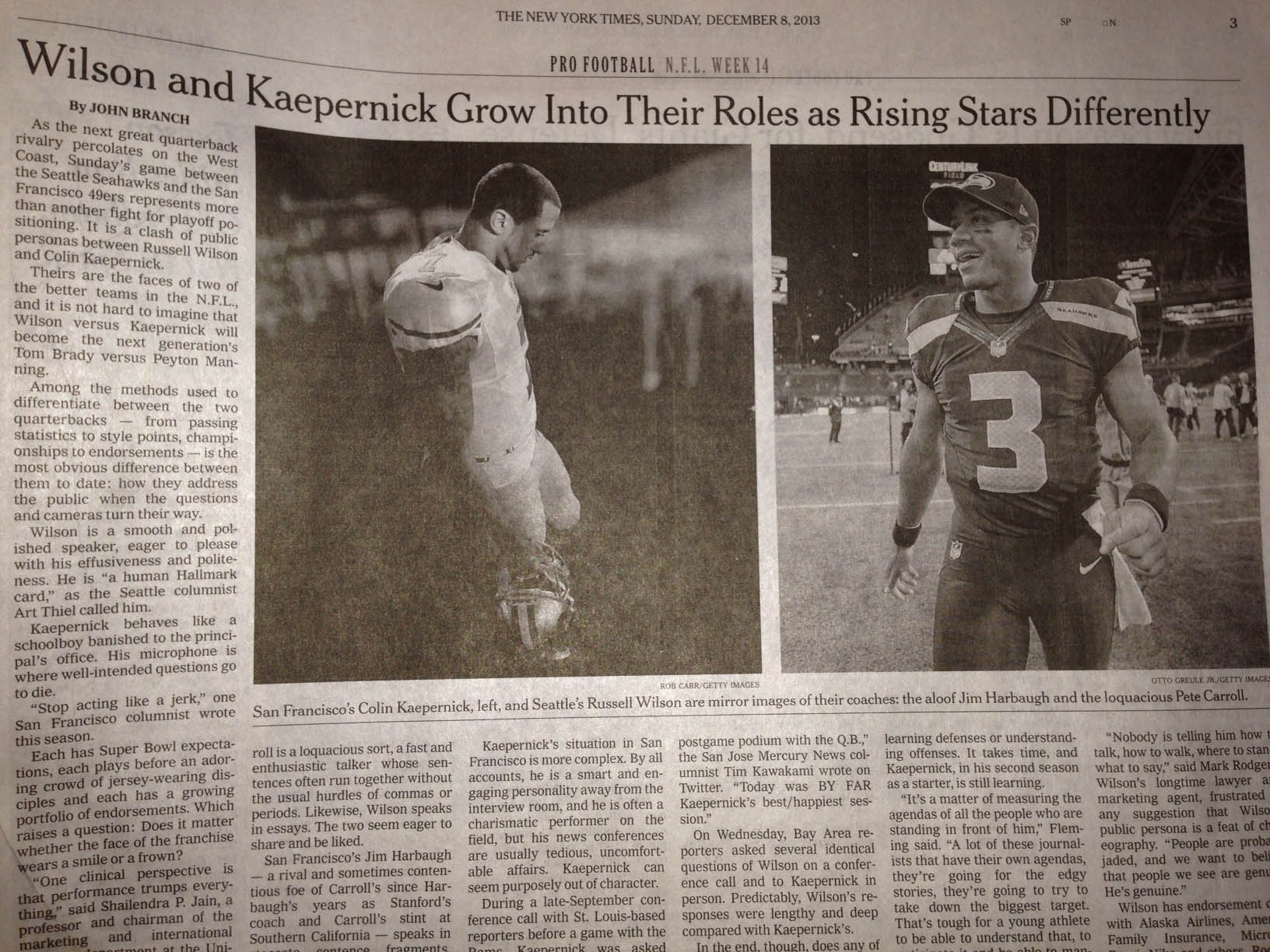
It’s nearly impossible not to like Russell Wilson! Not only is he a superstar in his second year in the league with the Seattle Seahawks but he is affable, outgoing, smart, personable and seems to have wisdom way beyond his years. Colin Kaepernick, who almost won a Super Bowl in his rookie year with the 49ers is similarly gifted as an athlete but with a much less outgoing interpersonal style, at least in front of the press. As a psychologist, I can infer that Kaepernick’s maternal abandonment and early adoption might have had an impact on his sense of trust and interpersonal style. Speaking in front of the media, not an easy task for any young adult, might be a greater challenge for him. Mr. Wilson is a pro in this regard but that’s highly unusual. From my perspective, anyone can judge and criticize but it takes toughness to be understanding. Let’s think about that the next time were critiquing someone without fully understanding who they are or how they were raised!

Category Archives: Psychology
An article in the Business section of the Sunday New York Times suggests that testosterone replacement therapy has become a marketing bonanza with sales of popular drugs like Androgel to treat “low-T” becoming blockbusters. The problem of course is that a lot of the trend is driven by profits and not necessarily effective research. Simple tests for low-T are so general that anyone stressed or depressed could fail them. For instance, do you have low energy or decreased libido? Many middle aged men might say yes when the underlying cause could be stress. Instead of using drugs with potentially harmful side effects like increased incidence of heart disease or cancer, psychotherapy or behavioral change is far safer and perhaps just as effective longer term. There simply isn’t enough research to keep up with all the marketing hype. Sound familiar? Money from drug sales often outcompetes the hard work of behavioral change. As always, sometimes drugs are necessary but many times they are simply profit centers for big business.
An article in the Sunday Review section of The New York Times addresses the link between insomnia and depression stating that new research suggests the link goes both ways. Anyone who has ever experienced insomnia knows this intuitively as sleep or lack of sleep clearly affects one’s mood. The research also suggests that brief cognitive behavioral therapy with an antidepressant pill is the best form of treatment. In my extensive clinical experience (30,000 plus hours) this advice is simplistic. I watched a famous doctor on television suggest that everyone with high blood pressure should be on medicine. Pills are problematic in general. For instance, research also suggests that regular exercise is just as effective in treating mild to moderate depression as antidepressants. Cognitive behavioral therapy for insomnia is a no-brainer. Medication, however, is often toxic to the body and has significant side effects that many doctors understate. Anyone who has ever been on an antidepressant understands this as well. Sometimes, drugs are necessary and clearly helpful but not without a cost. Behavioral change, though difficult, is a better long-term solution. If you are stuck in a job or relationship that you can’t stand or don’t have the skill to create, then a pill will have limited value. Finding the right coach, mentor or therapist and making tough decisions or difficult changes is often the best remedy. Pills should be a last resort.
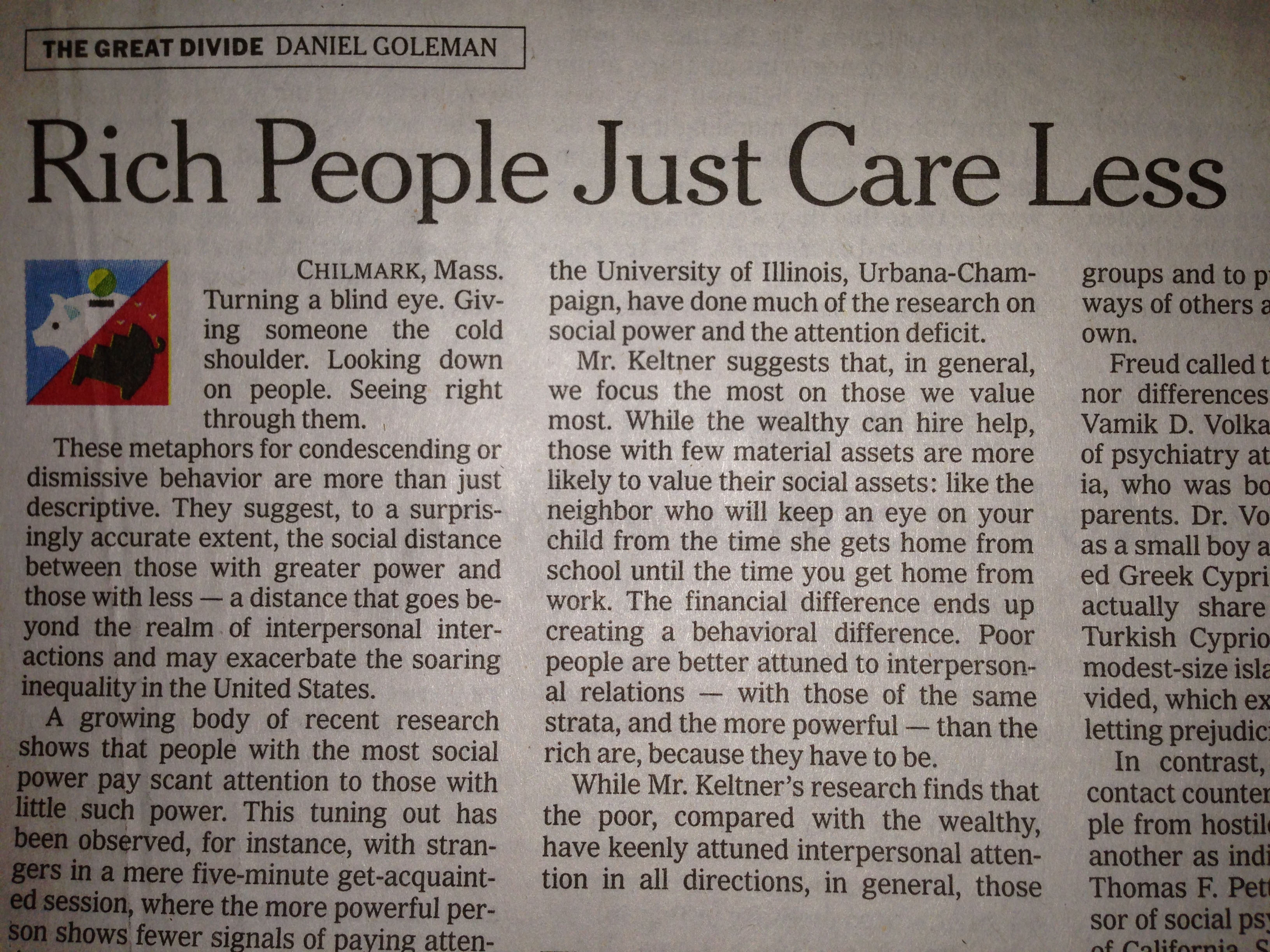
I have spent quite a lot of time with both the rich and the poor in my life. As a psychologist, especially in training, I worked in residential treatment centers and hospital settings with the homeless mentally ill and others of few means. I also worked with poor children at a Head Start program and taught in an inner city college environment. Being an identical twin to a Wall Street guy and having lived and worked in an affluent community for the past 17 years, I have a fair amount of exposure to the wealthy including many affluent friends and clients. In general, I agree with Mr. Goleman’s perspective that the wealthy and more powerful tend to “pay less attention to us than we do to them,” a prerequisite for empathy! Less empathy means less caring. I just read another article in the New York Times business section about the CEO of Bloomingdales who values empathy, caring, and listening a great deal. I loved reading about Mr. Gould and hope others in positions of power and authority will emulate him!
Having experienced several bouts of severe insomnia in my past I found it informative to find out something I ready knew: that although insomnia is painful emotionally and can lead to physical exhaustion and other challenges but one’s cognitive abilities remain largely intact. In other words, though you may feel less intelligent or capable as a result of much less sleep, in reality, you can function well regardless. I did. The challenge, of course, is to address the underlying cause and dynamics before one’s health and well-being is affected. For me, this was complex and multifaceted. For some, it may be less so: cut out substances that interfere with sleep like caffeine and change your job/ relationship or whatever is truly not working in your life. A really good coach or therapist might be helpful too. Sleeping pills are problematic and a slippery slope so be careful!
With a population just over twelve thousand, Malibu has 35 drug and alcohol rehab centers. With celebrity clients and a top notch location, facilities there can charge fees that are often two or three times going rates elsewhere – from 60 to 100 thousand dollars per month. Many programs are more new age too with less reliance on twelve step models and more customized treatment such as yoga, meditation, hypnotherapy and beyond. Is this a good thing? Perhaps for the wealthy but local residents are perturbed. As the French say: ce la vie!
As I read this article in the Wall Street Journal Weekend edition, I noticed one particular sentence that inspired me to write these thoughts: the . Underneath every addiction are emotions like anger, fear, loneliness, boredom, and anxiety that are being avoided or temporarily covered up by compulsive behaviors. I have worked with hundreds and hundreds of “addicts” in my lifetime and not one didn’t have some underlying pain that he or she was trying to avoid or hide. To be successful in life and overcome addictions in particular, we must face our emotions and not avoid them. With awareness, which means identifying the cues that trigger deleterious behavior, we can learn to substitute more positive behaviors for lousy ones like gambling, porn, alcohol, drugs, good, sex and so on!
I was sitting on the top floor of the Starbucks in Fairfield, Connecticut contemplating what makes life magical. Later that morning, I had a psychology/coaching session with a man in his early forties who used to be an investment banker. Several years ago, he went through a brutal depression and quit his job. In his twenties, he liked many aspects of being a banker; the technology research, the challenge of landing new clients, and the intensity of creating and delivering pitches. However, over time, he began to hate the long hours, endless travel, and the “jerks” that he interacted with on a daily basis.