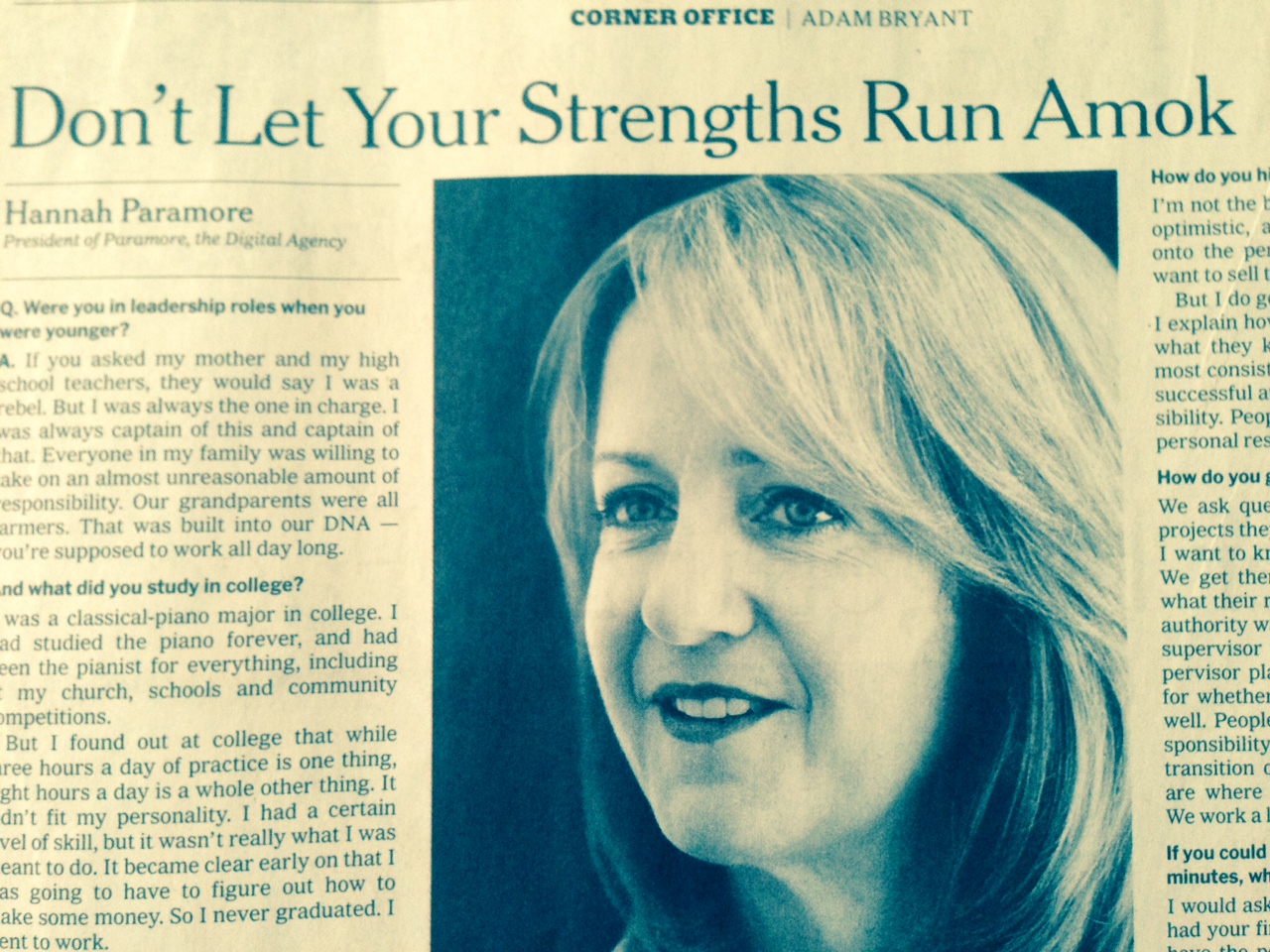
Adam Bryant interviews Hannah Paramore, president of the Digital Agency. Several things she said resonate with me: one is how important it is to take personal responsibility. I am working with a client now who has a pattern of running the negative emotions of jealosy and envy. I’m trying to teach him to shift his thought process and change a devastating cycle of emotional states that leave him weak and ineffectual. Taking personal responsibility for our emotions is at the core of successfully navigating relationships in business and intimacy. If you blame others for anything you are effectively giving your power away and acting like a victim. Powerful people make tough decisions and do something about situations that are not working for them. This may not be easy but it is the only way to take control over your life and business.
Tag Archives: business
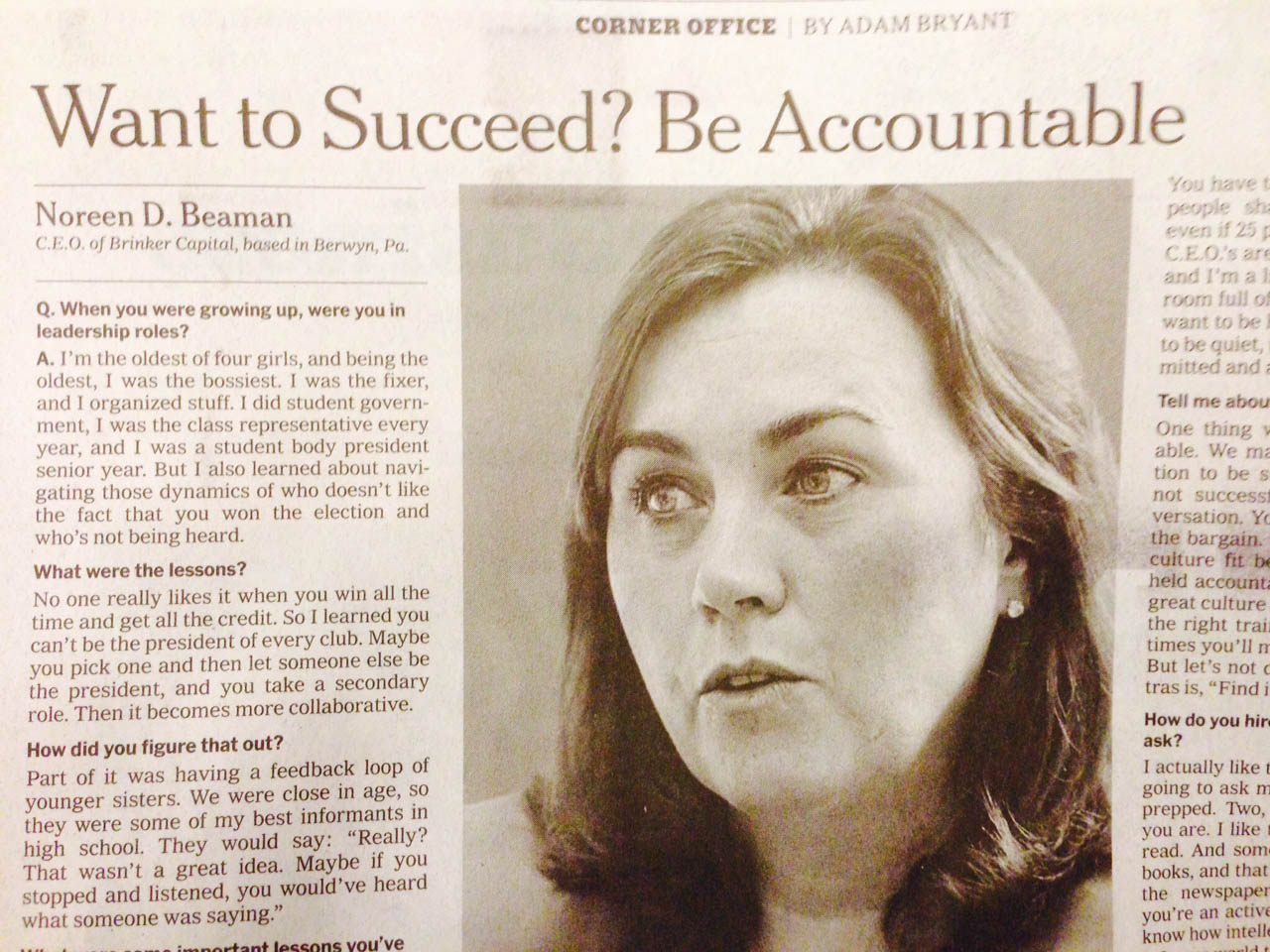
Noreen D. Beaman, the C.E.O of Brinker Capital, is a leader who values listening and being present. As she states in this interview with Adam Bryant, The New York Times Corner Office guru: “I’ve also learned a lot about listening – to really pay attention and be present in the moment.”
The story of Silk Road Founder Ross Ulbricht in the Sunday Business section of the New York Times is an interesting sketch on a complex personality. On the one hand, he seems to be kind, compassionate, and deeply philosophical young adult who graduated from several top schools, was well regarded by his peers and parents and found a way to create an interesting living confidentially matching buyers and sellers on the web using Bitcoin, a computer generated currency that is currently unregulated. On the other hand, Silk Road seems to have been set up primarily to provide buyers and sellers of illicit drugs and other illegal activities with a means of connecting anonymously through advanced encryption technology called Tor. Mr. Ulbricht believed strongly in economic freedom and extremely limited government. The FBI recently arrested him and charged him with a series of crimes that make him out to be a sociopath.
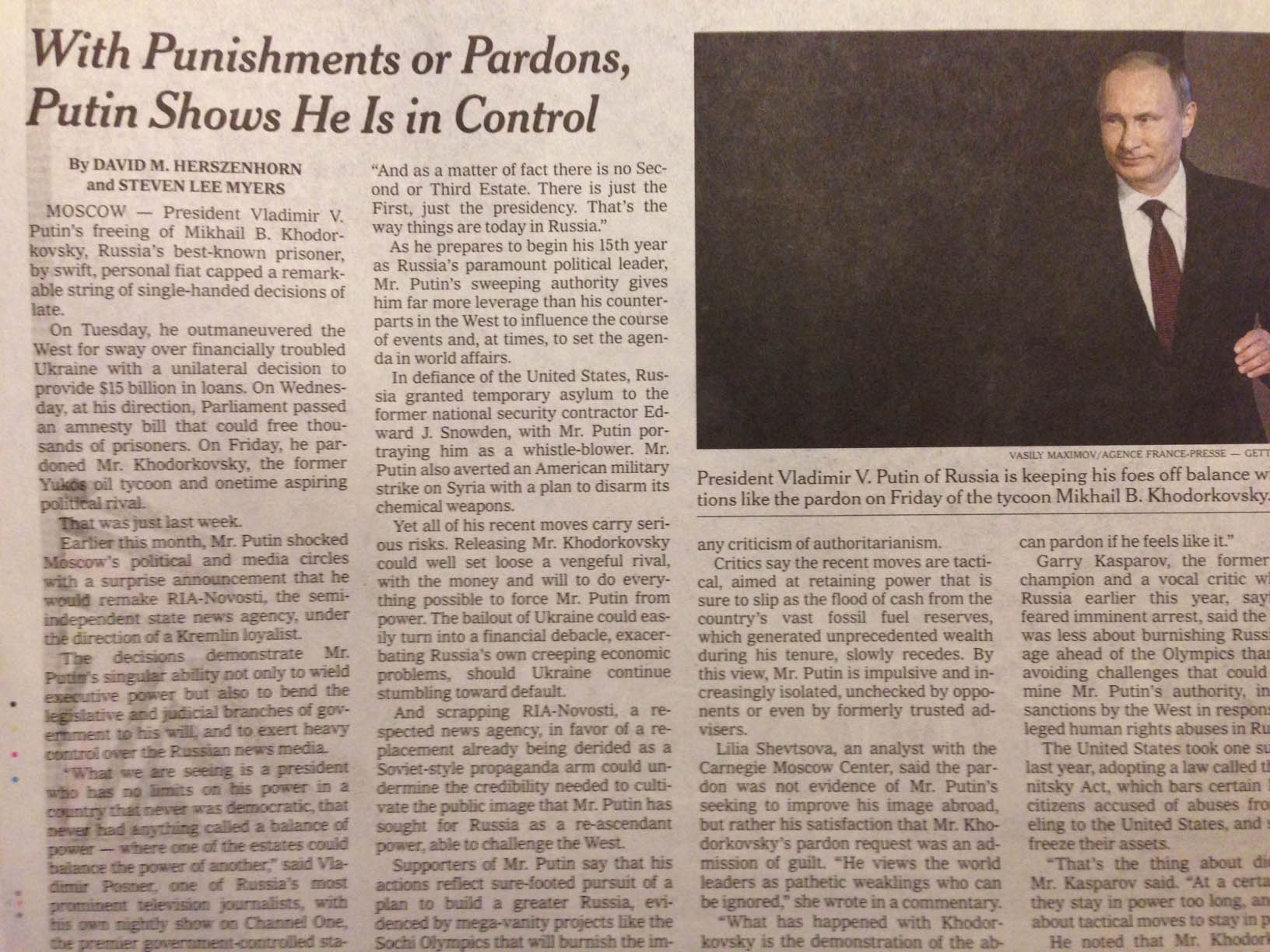
I find international politics and business fascinating. Each week, I read about Vladimir Putin somewhere. His grip on power in Russia is extraordinary and his strategic moves are equally fascinating! For instance, he gave Edward Snowden, the former U.S. government contractor, asylum in Russia basically giving President Obama and The United States the middle finger. In his latest move, he pardoned Mikhail Khodorkovsky, the billionaire tycoon imprisoned ten years ago on dubious charges of tax evasion. He seems like the ultimate power broker often out-maneuvering his western counterparts. On the one hand, he seems clever and bold. On the other hand, he seems downright diabolical. As a nation, Russia seems to repeat the same patterns (early childhood dynamics) over and over like most people do. With a long history of dictatorial and authoritarian rule, not all that much has changed. Changing old patterns, whether it is for an individual or a country is never easy. It takes time, patience, commitment, and desire. For now, much of that desire seems to be lacking in Russia or perhaps, it is simply too dangerous. All things change, however!
David Miliband, the former British politician, is reinventing himself in New York working for The International Rescue Committee, a nonprofit focused on helping the world of refugees. This Sunday Styles article made me think about the need to stay flexible and fluid in life and business, something I teach often. After losing the Labor Party leadership to his brother, he moved to New York with his family to start over. He’s obviously a smart, talented guy but the important message for you and me is that’s it’s never too late to reinvent oneself. It takes passion, patience and perseverance for many, especially if we are less talented and less connected. But what’s the alternative? Stagnation? Medication? Limbo? No way!
I love reading the Corner Office section of The New York Times Sunday Business section. This week Mr. Bryant interviews Lynn J. Good, the CEO of Duke Energy. Her sense of responsibility and dedication to others originated from parents who were educators with a tremendous work ethic. For instance, while growing up her neighbor was a widow and the family always called this neighbor before going to the supermarket or mowed her lawn as they did their own. Working at Arthur Anderson, the failed accounting firm, taught her that family, friends, and relationships are just as important as work and perhaps more important for happiness. I see a lot of executives whose lives are out of balance. I teach balance, harmony, and flow as fundamental to long term success in life and business! Ms. Good also addresses the value of communication for effective leadership. I couldn’t agree more. In fact, I would suggest that great communication is essential to happiness as well! People who form close ties and do intimacy well tend to be far happier than those who communicate poorly and struggle with relatedness.
I am a huge believer in taking a proactive approach to life, everywhere! I remember listening to Jimmy Johnson, the former super-bowl winning coach of the Dallas Cowboys in the 90’s, talk about another team running up the score on the loser. His perspective, which may seem a little harsh, was that the loosing team had no business complaining, instead they should get better so that running up the score never happens to them again. The essence of this perspective is to never ever blame another but to take total responsibility for your life and the outcomes in it. From a Spiritual perspective, everything in our reality is created by each of us, though not necessarily consciously.