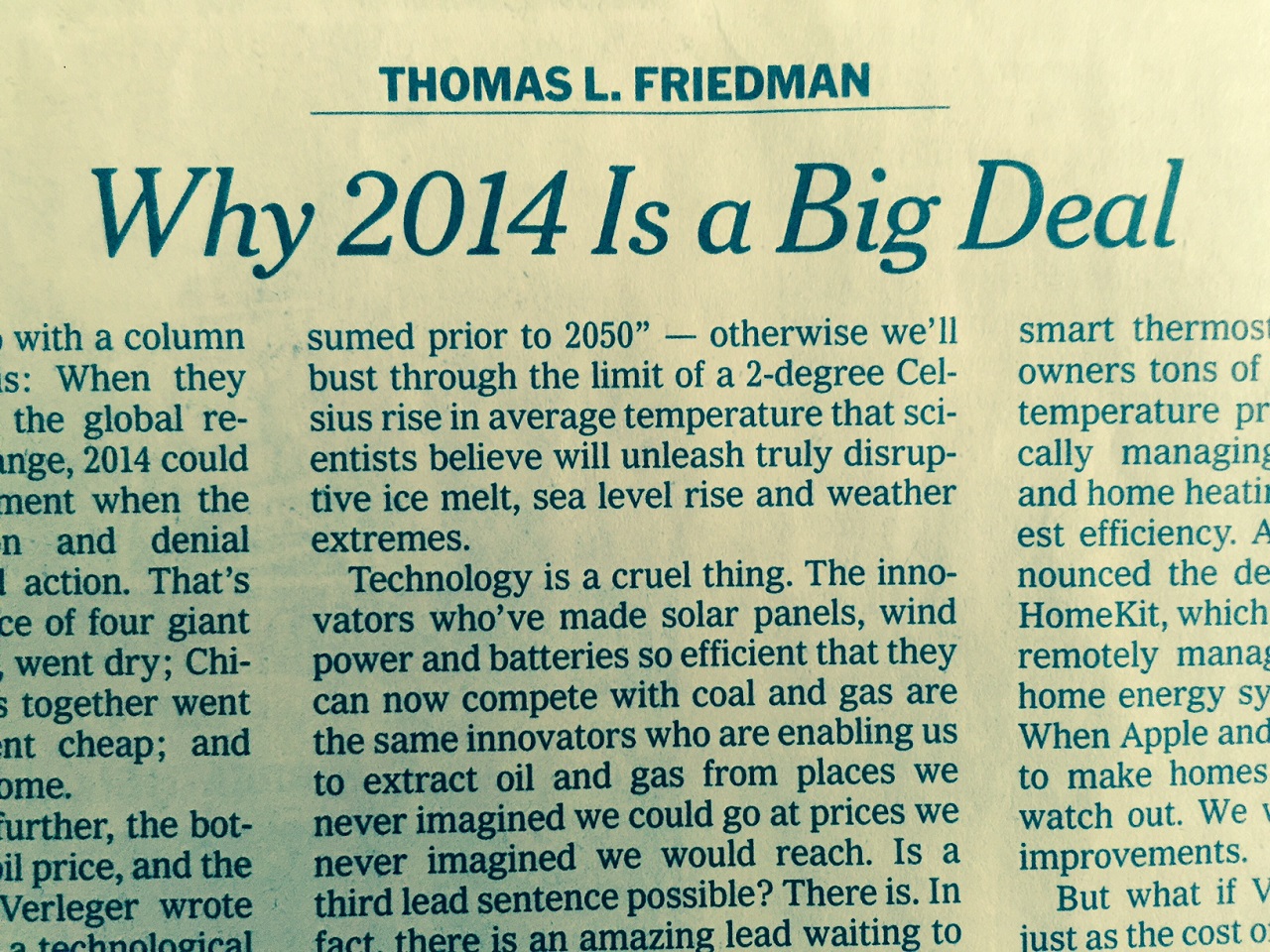
I really appreciate Thomas Friedman’s perspective on a wide range of issues! In his post in the Sunday Review section of the New York Times, Mr. Friedman summarizes the climate change issue. Essentially, climate change awareness and action as nations is crucial to our future and the future of mankind. He writes, “as the I.E.A warned, “no more than one-third of proven reserves of fossil fuels can be consumed prior to 2050″ – otherwise we’ll bust through the limit of 2-degree Celsius rise in ocean temperature that scientists believe will unleash truly disruptive ice melt, sea level rise, and weather extremes.”

Tag Archives: education
Nicholas Kristof, a celebrated New York Times columnist, has written a series of articles on racial issues in America several entitled, “Why whites don’t get it.” This poignant article on a 13 year-old black male who was sentenced to life in prison for shooting Debbie Baigrie in the face causing severe and lasting injuries. Though she suffered immensely from her ordeal, Ms. Baigrie has been in correspondence with her attacker, Ian Manuel, for over two decades even arguing on his behalf for early release.
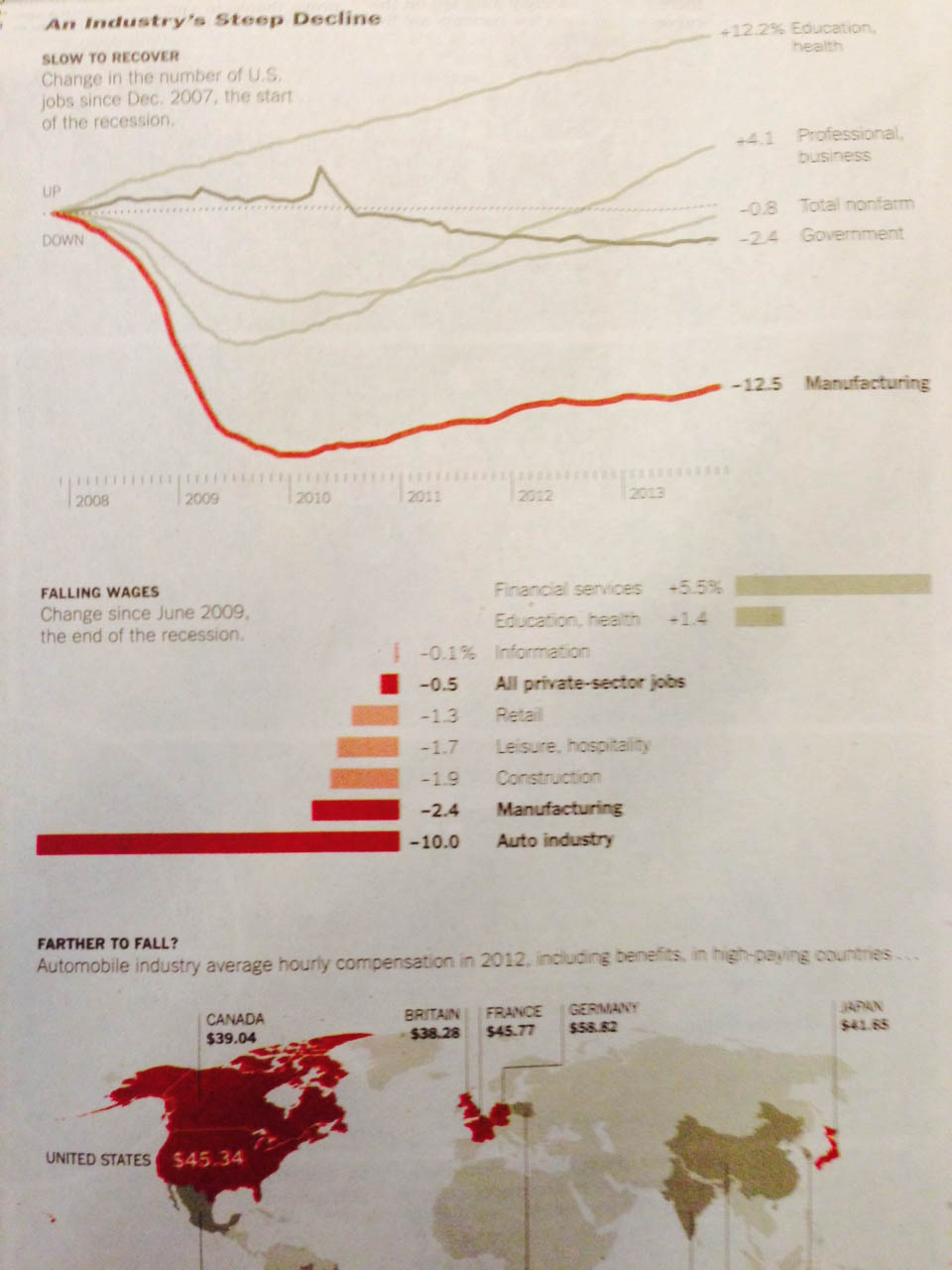
The Myth of Industrial Rebound, a feature article by Steven Rattner in this week’s Sunday Review section of The New York Times offers a broad perspective on the unlikely notion that high paid manufacturing jobs are ever coming back to the U.S. New plants that have opened recently are offering manufacturing jobs that start at wages that are hardly middle class like $12 to $14 an hour. The problems are multifaceted and diverse but essentially we don’t have enough skilled workers and we aren’t competitive enough compared to countries like Mexico whose average wage per worker is roughly $8 an hour versus $45 an hour in the U.S. Increased research and development, added spending on infrastructure, more foreign direct investment, and other policy changes will help but as Mr. Rattner argues, the issues are deeply structural in nature and unlikely to change significantly over time. He states: “in a flattened world, there will always be another China.”
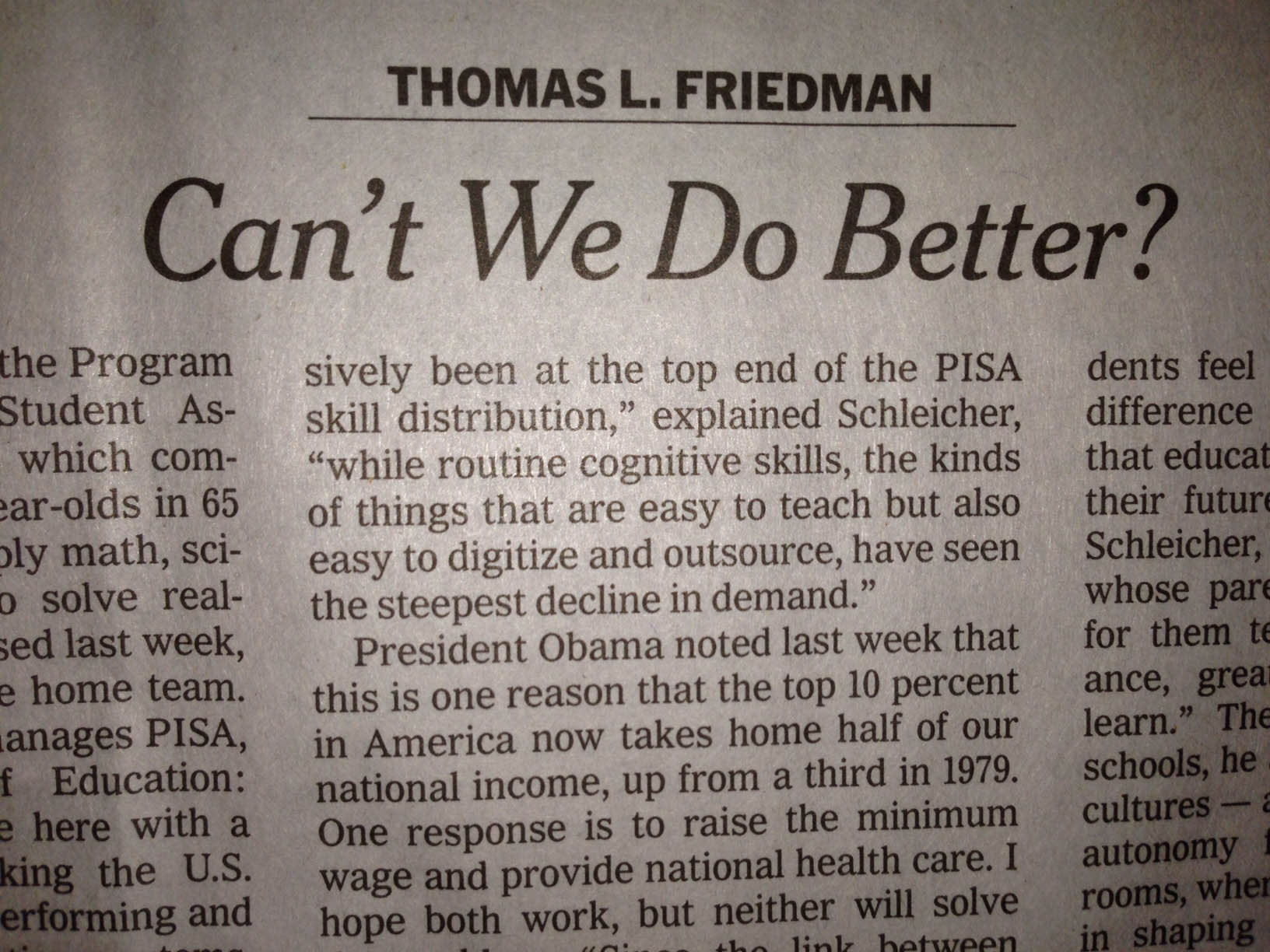
Friedman’s thoughts in the Review section of this week’s Sunday New York Times are worth considering. American workers are increasingly less competitive with other nations like India, China, Singapore, Poland, and Germany to name a few. The problems are systemic. We simply don’t do a good enough job educating our children to compete in an increasingly globalized and competitive world. The top ten percent of America now take home fifty percent of the national income. Income inequality is increasing. One solution is to learn from other countries who do a better job of providing autonomy, accountability, and ownership on a teaching and student level and who spend more per capita on less advantaged children. Having worked in inner city environments for years I have seen firsthand the systemic issues that create dynamics where poor and underprivileged children fall far behind their wealthier piers even by age five and certainly by age ten. We can and must do better!
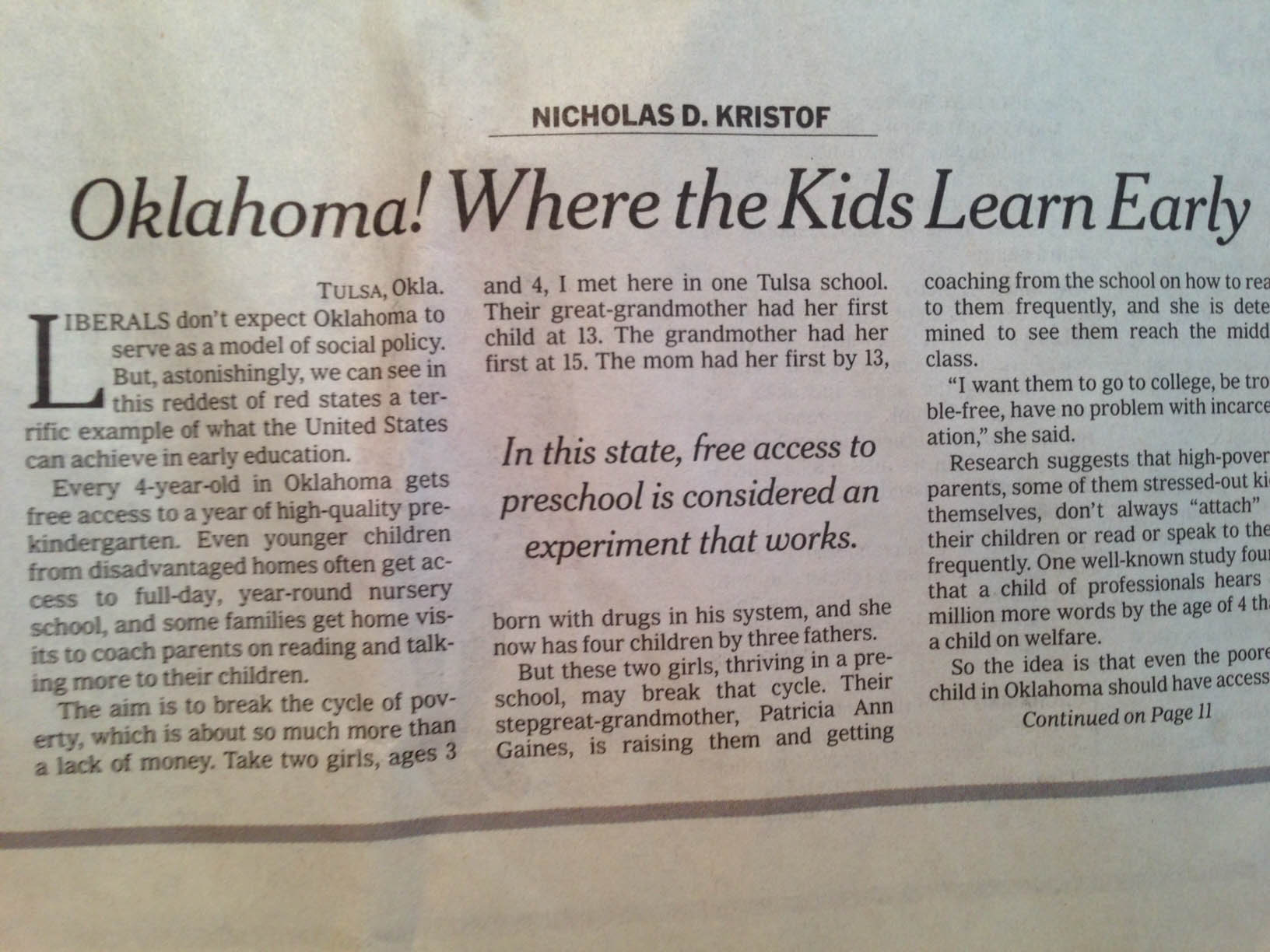
This picture is crinkled because The Sunday Review section of The New York Times traveled with me back from Los Angeles on a recent business trip. I took it with me because I agreed with Nicholas Kristof’s perspective on early intervention so much. As I have mentioned before, I worked at a Head Start Program (Federally mandated preschool for economically disadvantaged children) for three years in the late 90’s. I found the cycle of poverty, poor education, violence, and neglect among these children profoundly disturbing. What many middle upper class people don’t realize how far behind these children fall at such early ages and how much their emotional intelligence is impacted in early childhood. The Oklahoma experiment with mandated preschool for all four year olds and education for overwhelmed mothers sounds wonderful. I hope it succeeds and provides a model for other states!
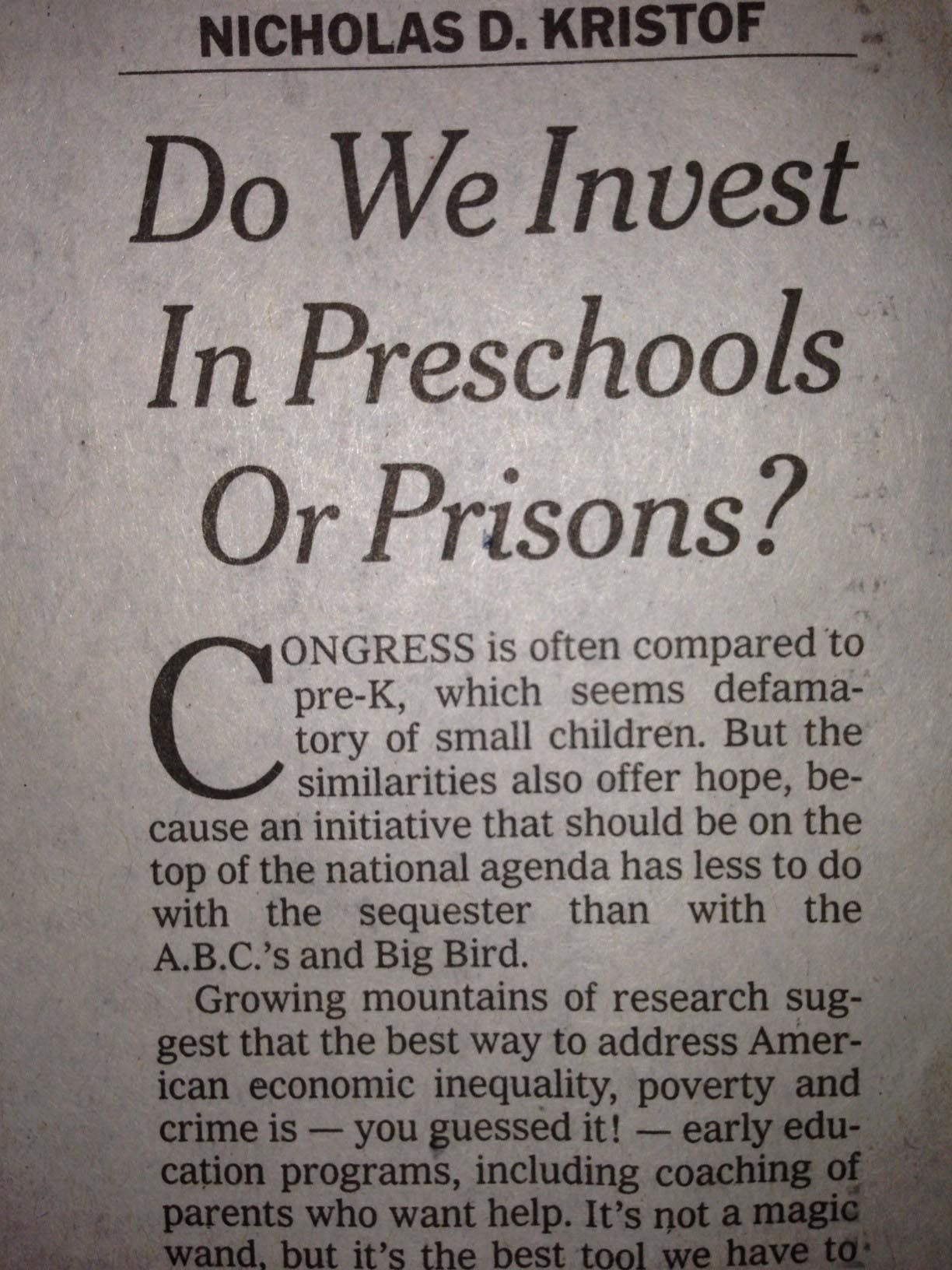
In his weekly column in the New York Times Review section, Nicolas Kristof discusses the fundamental need for America to address poverty and crime by investing in preschool education and other early childhood education programs. I worked as a mental health consultant for three years at a Head Start Program in South Norwalk, Connecticut. I saw firsthand the value of early childhood education and the need for it. These poor, mostly African American and Hispanic kids, even with assistance, had little chance at the kind of success and opportunity that wealthier children have and continue to have in America. By age 5, the achievement gap can be as much as two years. In affluent towns, the school systems and teachers are far more skilled at delivering high quality education and support. Impoverished inner city environments put a tremendous burden on the young. Many children are raised by young mothers who lack the skills and resources to parent well. Without additional early assistance, as Kristof writes, we will be increasingly jailing troubled adolescents and young adults who could have been saved.