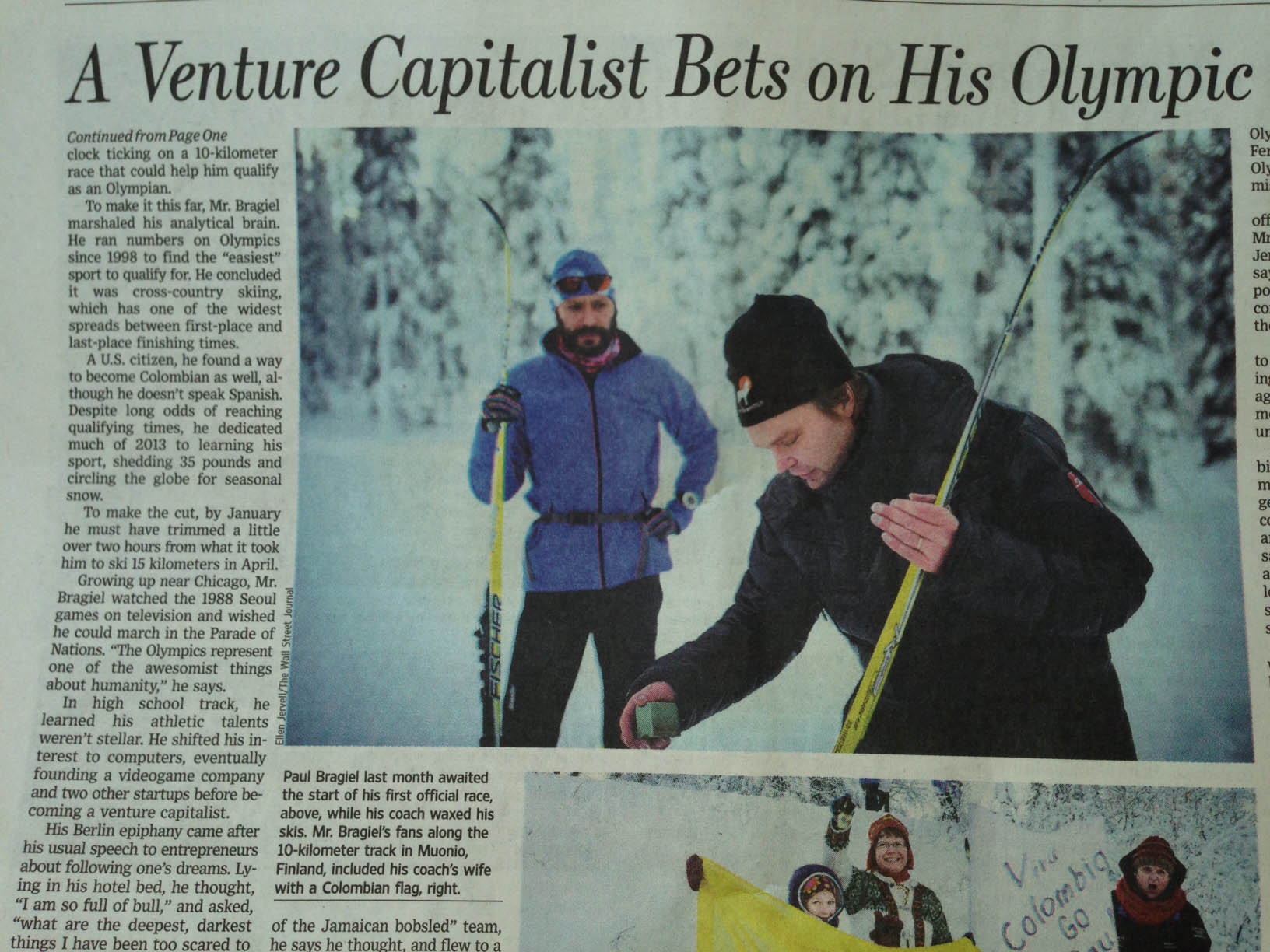
Paul Bragiel, a Silicon Valley entrepreneur, decided to take a break from his venture capital work and become an Olympian at age 36 with little true athletic ability. He chose cross country skiing because it is one of the least competitive of the ultra competitive opportunities available for elite athletes. He was able to obtain Columbian citizenship through his VC connections and now he is training nonstop to meet more stringent guidelines for Olympic eligibility. He has lost over thirty pounds in less than a year of training and has improved his times dramatically but still remains a long shot to qualify for the Winter Olympics in Sochi one of his lifelong dreams. Many people might think that he is nuts and perhaps he is a little but the process itself will change him forever and probably already has. I try to help every client I work with to create big dreams and then we create a game-plan to fulfill them. Even if you fall short, the process of stretching and pushing oneself can be extraordinary in terms of growth and confidence. Striving for continuous self improvement is one of the best ways to live!
Tag Archives: life coach
It’s inspiring to hear Nelson Mandela’s story over and over. The desire to contribute, to change the world for the better, to learn, grow, change, evolve and persevere is only a small part of his legacy. I love to help people, especially young adults, develop these characteristics in themselves because when more of us live this way, the better the world becomes for the rest of us! Thank you Mr. Mandela for contributing to and inspiring so many!!
I love reading the Corner Office section of The New York Times Sunday Business section. This week Mr. Bryant interviews Lynn J. Good, the CEO of Duke Energy. Her sense of responsibility and dedication to others originated from parents who were educators with a tremendous work ethic. For instance, while growing up her neighbor was a widow and the family always called this neighbor before going to the supermarket or mowed her lawn as they did their own. Working at Arthur Anderson, the failed accounting firm, taught her that family, friends, and relationships are just as important as work and perhaps more important for happiness. I see a lot of executives whose lives are out of balance. I teach balance, harmony, and flow as fundamental to long term success in life and business! Ms. Good also addresses the value of communication for effective leadership. I couldn’t agree more. In fact, I would suggest that great communication is essential to happiness as well! People who form close ties and do intimacy well tend to be far happier than those who communicate poorly and struggle with relatedness.
An article in the Sunday Review section of The New York Times addresses the link between insomnia and depression stating that new research suggests the link goes both ways. Anyone who has ever experienced insomnia knows this intuitively as sleep or lack of sleep clearly affects one’s mood. The research also suggests that brief cognitive behavioral therapy with an antidepressant pill is the best form of treatment. In my extensive clinical experience (30,000 plus hours) this advice is simplistic. I watched a famous doctor on television suggest that everyone with high blood pressure should be on medicine. Pills are problematic in general. For instance, research also suggests that regular exercise is just as effective in treating mild to moderate depression as antidepressants. Cognitive behavioral therapy for insomnia is a no-brainer. Medication, however, is often toxic to the body and has significant side effects that many doctors understate. Anyone who has ever been on an antidepressant understands this as well. Sometimes, drugs are necessary and clearly helpful but not without a cost. Behavioral change, though difficult, is a better long-term solution. If you are stuck in a job or relationship that you can’t stand or don’t have the skill to create, then a pill will have limited value. Finding the right coach, mentor or therapist and making tough decisions or difficult changes is often the best remedy. Pills should be a last resort.
An article in the Sunday Review section of The New York Times by Mary Lou Jepson, a Silicon Valley entrepreneur, is fascinating. It took years of increasingly desperate and bizarre symptoms for doctors to finally discover a pituitary tumor that decimated her body’s ability to produce hormones, especially cortisol, a stress hormone key to immune function. Being proactive, she took it upon herself to get the proper treatment when many doctors dismissed her needs or didn’t get proactive enough themselves. As she writes: “without the ability to fine-tune my hormones and neurochemicals I believe I would have been trapped as a near-imbecile, wheelchair-bound, in my mother’s basement for an abbreviated and miserable adult life.” I coach everyone I work with to develop and trust their instincts, and be proactive and engaging! Clearly, Ms. Jepson’s ability to do so has been a huge part of her recovery and success. Great job!!
This picture is crinkled because The Sunday Review section of The New York Times traveled with me back from Los Angeles on a recent business trip. I took it with me because I agreed with Nicholas Kristof’s perspective on early intervention so much. As I have mentioned before, I worked at a Head Start Program (Federally mandated preschool for economically disadvantaged children) for three years in the late 90’s. I found the cycle of poverty, poor education, violence, and neglect among these children profoundly disturbing. What many middle upper class people don’t realize how far behind these children fall at such early ages and how much their emotional intelligence is impacted in early childhood. The Oklahoma experiment with mandated preschool for all four year olds and education for overwhelmed mothers sounds wonderful. I hope it succeeds and provides a model for other states!
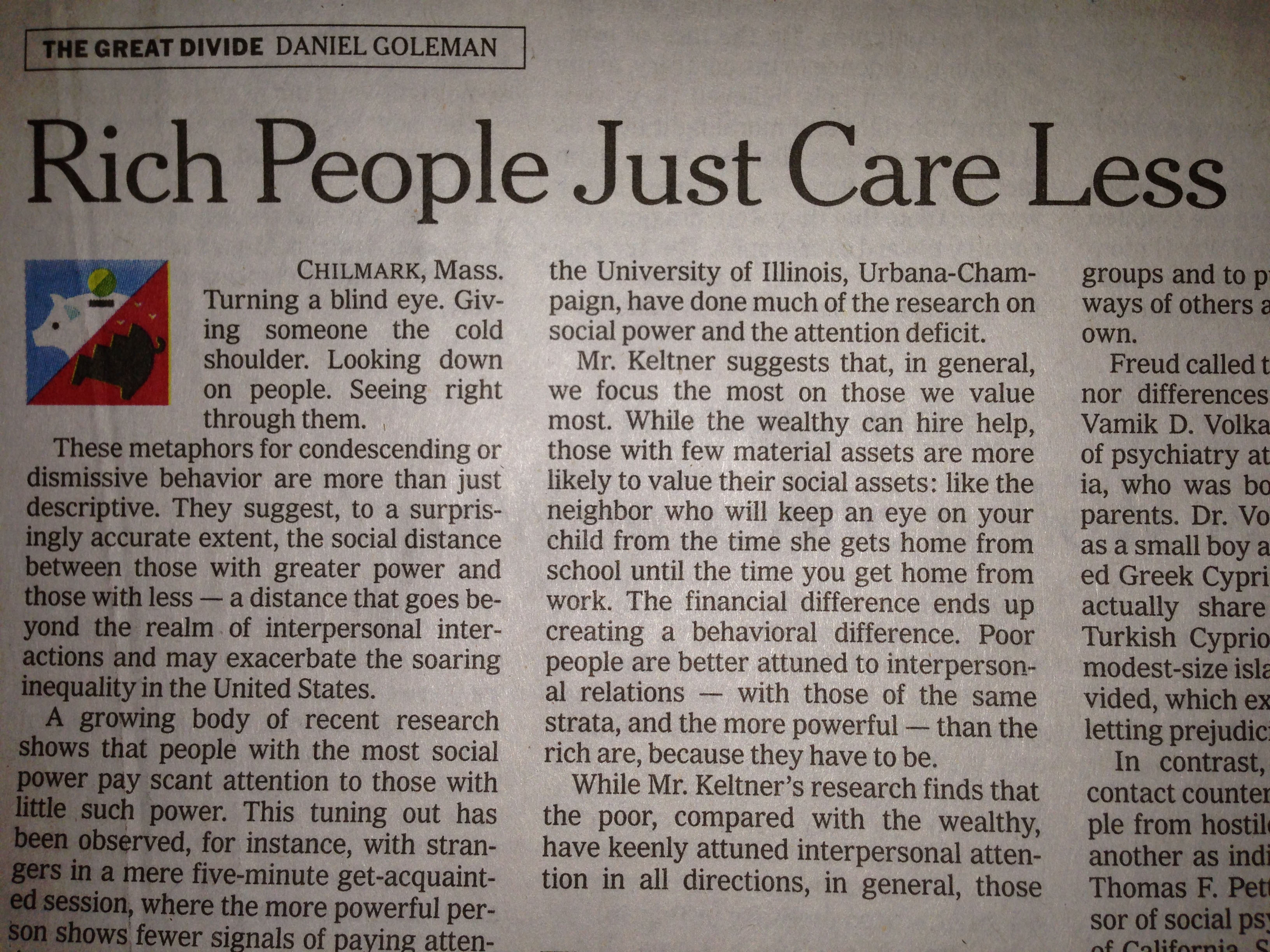
I have spent quite a lot of time with both the rich and the poor in my life. As a psychologist, especially in training, I worked in residential treatment centers and hospital settings with the homeless mentally ill and others of few means. I also worked with poor children at a Head Start program and taught in an inner city college environment. Being an identical twin to a Wall Street guy and having lived and worked in an affluent community for the past 17 years, I have a fair amount of exposure to the wealthy including many affluent friends and clients. In general, I agree with Mr. Goleman’s perspective that the wealthy and more powerful tend to “pay less attention to us than we do to them,” a prerequisite for empathy! Less empathy means less caring. I just read another article in the New York Times business section about the CEO of Bloomingdales who values empathy, caring, and listening a great deal. I loved reading about Mr. Gould and hope others in positions of power and authority will emulate him!
When I read this article in The New York Times Magazine I had a dizzying array of thoughts – first, I love the game and believe it’s great that the international community is embracing it more and more. However, eight-year-olds pushed by their parents to train as if it were their full time job is a little frightening. I coached an architecture student at Pratt University in Brooklyn last year who was under enormous pressure to keep up with foreign (especially Chinese) students who regularly pulled all-nighters studying for exams. Sometimes, growth and competition can be a bad thing. Where is the emphasis on Being?, the essence of happiness, not just more and more Doing one might ask.
I have a client who has experienced a bruising decade long battle with his wife due to her anger, alcoholism and blame. Despite my client’s many efforts to get her help and get control over their financial situation, she refused. Eventually they got divorced but not before his finances were decimated, his health impaired, and his family torn apart. Nevertheless, I still asked him what he could do that would inspire him? Given his state of affairs and the anger he felt both towards himself and his wife, this was no easy question. And yet, he looked at me intently and said, “my writing, I could get back to writing.”
What inspires you to be great? I love asking people this question. Some people think of world leaders like Nelson Mandela or even JFK. Others think of Astronauts, test pilots, or famous race car drivers like Danica Patrick. Still other people think of famous business leaders like Steve Jobs and Jack Welch or top athletes like Michael Jordan and Tiger Woods. And then there are celebrities like Angelina Jolie or Russell Crowe.